Overview
Twilight Princess is often praised for individual dungeons, but its larger structural intelligence is just as important. The game does not simply place nine story chapters in a line. It arranges them so that each phase changes the meaning of the next one. The result is a route that keeps expanding in scale without feeling shapeless.
That momentum comes from two linked ideas. First, each dungeon introduces or reinforces a mechanical grammar that the player will keep speaking later. Second, the sequence keeps changing the emotional purpose of the space itself. Early dungeons restore order. Midgame dungeons reveal history. Late-game dungeons test how much of the earlier learning the player can carry under pressure.
The First Three Dungeons Build a Play Grammar
The opening trio is doing more than proving that the player can solve Zelda rooms. The Forest Temple, Goron Mines, and Lakebed Temple teach how Twilight Princess wants item logic, regional stakes, and boss payoff to relate to one another. Each one says, in effect, "learn the tool, read the environment, then use the new item as the language of resolution."
This is why the early pace can feel patient without becoming inert. By the end of Chapter 3, the player has not only cleared three themed spaces. They have absorbed the game's sentence structure. That makes the later experiments possible.
The Middle Sequence Changes the Question the Game Is Asking
The middle-game dungeons are where Twilight Princess becomes far more interesting than a straightforward province-cleansing adventure. Arbiter's Grounds, Snowpeak Ruins, and the Temple of Time do not feel like variants of the same task. Each one changes the story's frame. The desert introduces buried judgment and the mirror quest. Snowpeak shifts into melancholy domestic space. The Temple of Time turns the route toward inherited history and ceremonial architecture.
In other words, the middle sequence is where dungeon order becomes narrative argument. The game is no longer asking only whether Link can solve the next space. It is asking what kind of world Hyrule used to be, what has been hidden, and why the quest now feels older and stranger than it did in the first province arc.
Late-Game Dungeons Stop Expanding and Start Converging
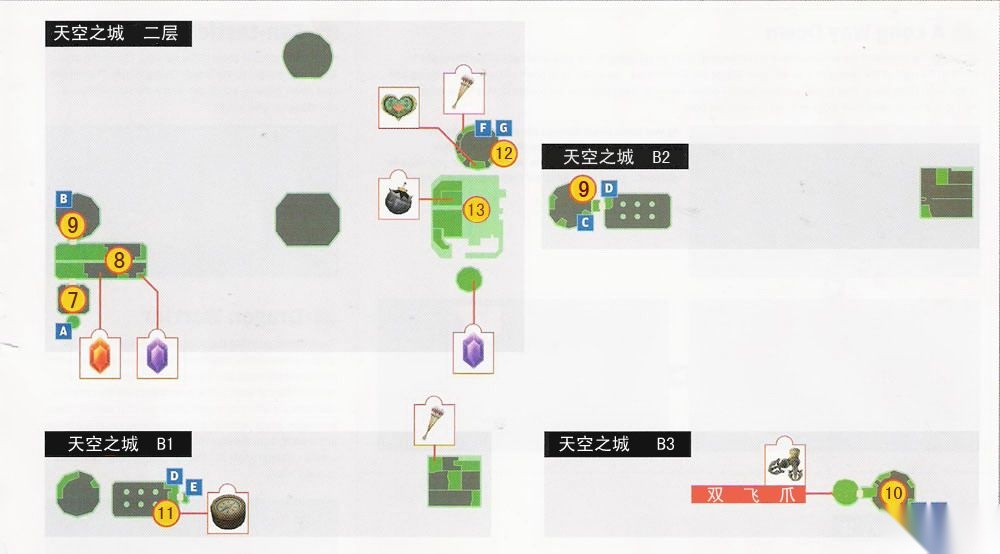
By the time the route reaches City in the Sky, Palace of Twilight, and Hyrule Castle, the game mostly stops opening sideways. It starts folding inward. New traversal is still exciting, but the real emphasis is convergence: recovered history, solved mirror shards, exposed authority, and the final movement toward closure.
This is why the late-game rhythm feels faster even when the spaces remain large. The story is no longer teaching a world. It is cashing one out. City in the Sky completes the mirror hunt, Palace of Twilight resolves the hidden political center of the game, and Hyrule Castle compresses everything into a final proof of mastery.
The Item Order Makes Return Visits Feel Earned
One of the cleanest design choices in Twilight Princess is that its items do not merely unlock the room they were found in. They also make older places thinkable in new ways. The Spinner redefines movement logic. The Ball and Chain makes brute physical interaction satisfying. The Dominion Rod turns static architecture into route control. Double Clawshots transform the very feeling of space.
Because these items arrive in a carefully shaped order, optional cleanup never feels completely separate from the main adventure. The appendix becomes more useful precisely because the dungeon order has already prepared the player to revisit the world with a broader toolset. That is pacing value, not just collectible value.
Where to Read This Structure Across the Site